

First, the bad news: Your memory speed naturally declines by about 2 percent each decade, starting in your late 20s. (Hence the lost keys and tip-of-the-tongue Jeopardy! trivia.) But the really good news? There are lots of research-backed strategies to keep your noggin sharp over time, says Gary Small, MD, director of the UCLA Longevity Center. Read on to discover key facts about your brain.

Emotions can muddy your recall
Ever wonder how a witness to a crime can see one thing and think she saw something totally different? Her account may be skewed by fear, explains Gary Wells, PhD, a psychologist at Iowa State University who specializes in eyewitness testimony. “Fear triggers a survival response that uses up cognitive resources, so the emotion can impair memory encoding,” he says.
There’s no “flashbulb memory”
Some people swear the details of an event are frozen in their mind like a photograph. Not likely, experts say. “Our memories are more like a narrative that we continually edit,” says Charles A. Weaver III, PhD, chair of psychology and neuroscience at Baylor University in Waco, Texas. Research into people’s recollections of 9/11 showed that more than 70 percent claimed they remembered seeing live footage of the first plane hitting the World Trade Center, even though video of the crash didn’t become available until later.
Deja vu is for real
“It’s a response based on a general feeling of familiarity,” Weaver explains. It may be that a particular scent or sensation has triggered a related, dormant memory, making the current situation feel familiar.
RELATED: 9 Foods That May Help Save Your Memory
Stress makes you spacey
In a study at the Washington University School of Medicine in St. Louis, people who received high doses of the stress hormone cortisol daily for four days performed worse on recall tests than those in the control group. And University of Pittsburgh researchers discovered that women who reported feeling high levels of stress over the course of 20 years had decreased volume in the right side of the hippocampus. Fortunately, other studies have shown that relaxation techniques like meditation, yoga and tai chi can have memory-enhancing benefits. Anything that calms you down should have the same effect, whether it’s chatting on the phone or going for a run.
Memory blips are nothing to fret about
Tip-of-the-tongue experiences can feel freaky. But a reassuring study from the University of Virginia found that these little lapses are not likely related to cognitive drop-off. “Your ability to quickly access info starts to decline naturally as early as your 30s,” says James Leverenz, MD, Cleveland director of the Lou Ruvo Center for Brain Health at the Cleveland Clinic. And chronic multitasking (which many of us do) only makes it tougher to focus. “The brain cells storing the factoid you’re searching for haven’t died—they just need to be dusted off,” Dr. Small says. Other totally normal memory mishaps: trouble recalling what you did last month or a year ago, and a phenomenon called “scrambling” (when minor details get mixed up in your head). A sign you should worry? You or your loved ones notice that you’re progressively struggling with daily activities—like balancing your checkbook or cooking your favorite meal. In that case, visit a neurologist.
S: health.com
To keep you feeling full and satisfied, a snack should provide a balance of good carbs and either protein, fat, or both. In other words, eating just a few carrots won’t suffice—and neither will many granola bars. Read (and pin!) our list of perfect anytime snacks.
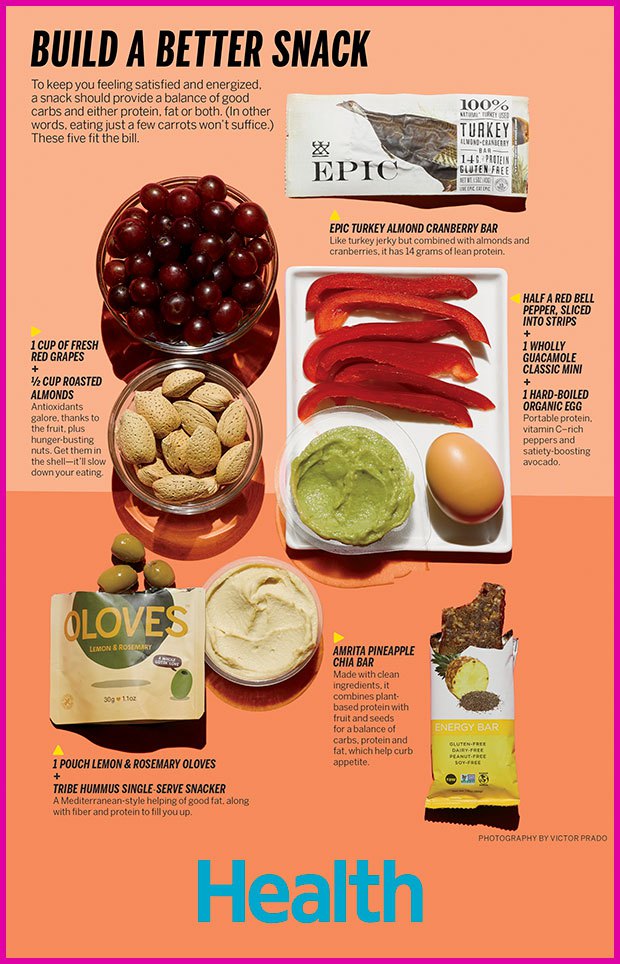
1 cup of fresh red grapes + ½ Cup roasted almonds
Antioxidants galore, thanks to the fruit, plus hunger-busting nuts. Get them in the shell—it’ll slow down your eating.
Epic turkey almond cranberry bar
Like turkey jerky but combined with almonds and cranberries, it has 14 grams of lean protein. ($29 for a pack of 12, amazon.com)
Half a red bell pepper, sliced into strips + 1 Wholly guacamole classic mini + 1 Hard-boiled organic egg
Portable protein, vitamin C-rich peppers and satiety-boosting avocado. (Wholly
1 Pouch lemon & rosemary Oloves + Tribe hummus single-serve snacker
A Mediterranean-style helping of good fat, along with fiber and protein to fill you up. ($50 for a pack of 30 Oloves, amazon.com)
Amrita pineapple chia bar
Made with clean ingredients, it combines plant-based protein with fruit and seeds for a balance of carbs, protein and fat, which help curb appetite. ($33 for a pack of 12, amazon.com)
Why do my muscles get sore before my period?
Although abdominal cramps tend to be the most talked-about sign of PMS, joint or muscle pain throughout your body is fairly common around that time of the month, too. Blame hormonal fluctuations, which can make your nerve endings extra sensitive and more likely to perceive regular muscle activity as pain.

If you’re prone to premenstrual aches, you might want to hold off on getting a bikini wax or trying a new gym class until your period is in full swing, because you’ll feel pain more strongly when you’re PMS-ing. If the soreness is regular and severe, talk to your doc about long-term treatment options, like going on a birth control pill to help regulate your hormone levels. Otherwise, over-the-counter anti-inflammatories can bring relief.
In the meantime, taking good care of yourself—getting enough sleep, exercising regularly and reducing stress—can help minimize this and other annoying PMS symptoms.
S: health.com
In 2002, arthritis sufferer Joe de Casa was working in his Northamptonshire garden in England when a venomous snake bit him. After surviving the bite, de Casa, who struggles with arthritis, claimed that the following months provided his only pain-free days in years
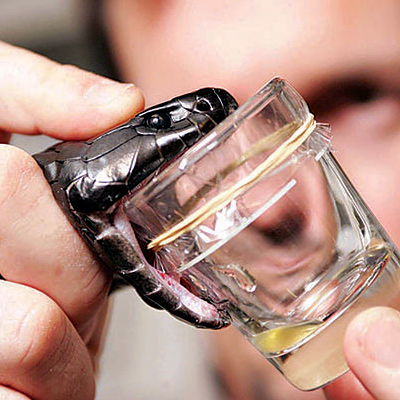
Such anecdotal claims, including teachings in India’s centuries’ old Ayurveda traditional medicine system, may hold some truth. Venomfrom cobras may not only treat arthritis, but also prevent further damage from the condition.
Scientists have just determined that Indian monocellate cobra venom displayed anti-arthritic activity during lab tests on rodents, according to a paper that will be in the February-March issue of the journal Toxicon.
While clinical trials on humans are still needed, a cobra venom arthritis ointment is in the works, lead author Antony Gomes told Discovery News.
“We have already prepared such an oil-based preparation (for topical application), which is showing very promising results on humans,” Gomes, a professor of physiology at the University of Calcutta, said.
“As soon as the patent protocol (period) is over, we wish to go for industrial collaboration for marketing,” he added.
For the study, Gomes and his colleagues induced arthritis in lab rats by injecting them with a saline and olive oil solution containing tuberculosis bacteria, which can cause arthritis.
The researchers collected Indian monocellate cobra venom from adult males and females housed at Calcutta Snake Park. The team then administered a nonlethal dose of venom to some of their lab rodents.
Rats without the venom treatment suffered from cartilage damage and swollen limbs. These symptoms, however, were not present in the venom-treated rats, based on paw weight and measurements.
Chemical analysis, according to the researchers, revealed that the venom actually prevented cartilage damage by inhibiting collagen breakdown. Collagen is one of the main proteins found in skin, bone and other parts of the body.
Gomes believes venom from other snake species, such as those in the Elapidae family, should also combat arthritis. This family includes relatively tiny crowned snakes to the king cobra, which is the world’s longest venomous snake, measuring up to 18.5 feet in length.
Venom from other animals and insects, such as bees, may also fight arthritis.-landing-aircraft-design.html”]bees, may also fight arthritis.
Jin Tae Hong of South Korea’s Chungbuk National University and his team determined that bee venom also treats rats with induced inflammatory arthritis.
“Our data show that the anti-arthritic effects of bee venom are related to the anti-inflammatory effects of bee venom,” Tae Hong said.
Inflammation is the body’s response to injury or irritation, so it might be in the best interest of a venomous snake or insect to prevent this process in order to make the venom more potent.
Each year, tens of thousands of people worldwide die from snakebites, so researchers continue to try to isolate beneficial components from otherwise deadly venoms.
S